Coupling Guards: The Simple Metal Component That Can Make a Big Difference
By the MetalMade Team | Sheet Metal Fabrication, Cape Town
If you've ever worked around industrial machinery, pumps, motors, drive systems or rotating equipment, you'll know that some of the most important components aren't necessarily the ones doing the obvious work.
A coupling might be quietly transferring power between two pieces of machinery, for example, while the component protecting it is easy to overlook.
That's where a coupling guard comes in.
At MetalMade, coupling guards are one of the specialist products we fabricate alongside drip trays, flues, turbo cowls and other custom metalwork. In this post, we're looking at what a coupling guard actually does, why it's important, and why having one fabricated to suit the equipment can make a significant difference.
So, What Exactly Is a Coupling Guard?
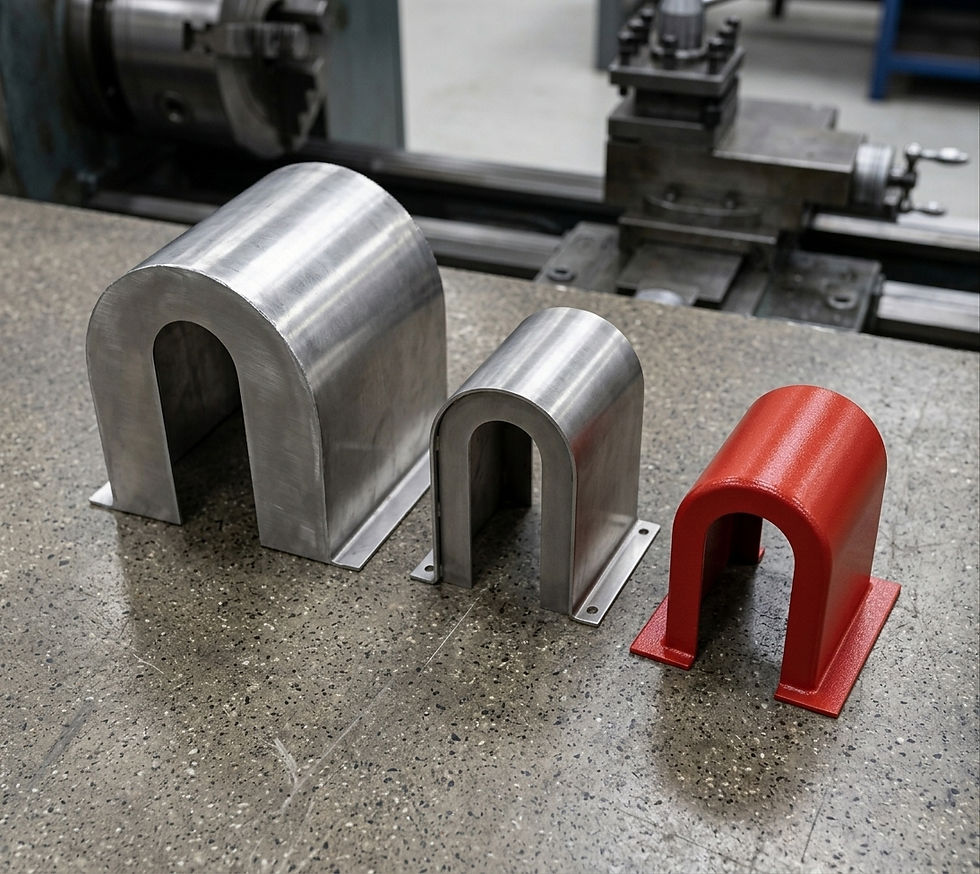
A coupling guard is a protective metal enclosure fitted around a shaft coupling or similar rotating mechanical component.
The coupling itself has an important job: it connects rotating components and allows power to be transferred between them. But because it involves moving parts, it also needs to be properly protected.
A coupling guard creates a physical barrier between the rotating equipment and the surrounding environment.
In practical terms, it can help:
Reduce the risk of accidental contact with moving components
Protect the coupling from external interference
Keep clothing, tools and other objects away from rotating machinery
Provide a more controlled and protected installation
Create a purpose-built solution around the dimensions of the equipment
It might not be the most exciting part of a machine, but it is a very practical one.

Why Does a Coupling Need Protection?
Rotating machinery creates obvious hazards.
A shaft and coupling can rotate at considerable speed, and anything that gets too close can potentially become caught or damaged. In a working environment where machinery is regularly accessed for maintenance, cleaning or inspection, having a physical guard around exposed rotating components is an important consideration.
A coupling guard isn't intended to replace proper machine guarding, safe operating procedures or risk assessments. Instead, it forms part of the physical protection around a particular mechanical assembly.
And because machinery installations aren't all identical, the guard itself often needs to be designed around the equipment.
That's where custom fabrication becomes useful.
One Size Doesn't Always Fit All
This is one of the biggest advantages of having a coupling guard fabricated rather than simply looking for an off-the-shelf solution.
Every installation can be different.
You may have different:
Coupling dimensions
Shaft sizes
Mounting arrangements
Available clearance
Equipment layouts
Access requirements
Fixing points
A guard that works perfectly on one machine may simply not be suitable for another.
A custom-fabricated guard can be designed around the actual dimensions and configuration of the equipment, giving you a much more practical solution than trying to make a standard component work where it wasn't designed to.
Why Sheet Metal Works So Well for Coupling Guards
Sheet metal is an incredibly versatile material for protective guards.
It can be cut, bent, rolled and formed into shapes that follow the requirements of the machinery, while still providing a robust physical barrier.
At MetalMade, we work with different sheet-metal materials and thicknesses depending on the requirements of the job. Our workshop is equipped with a 3-metre guillotine, a 3.2-metre press brake and rolling machinery, as well as jenny and lock-forming machines.
That means we're able to take a set of measurements or specifications and turn them into a practical fabricated component rather than relying solely on standard sizes.
Custom Fabrication Means More Than Just Making It Fit
When you're fabricating a component for machinery, simply making something that fits isn't necessarily enough.
The guard needs to work with the surrounding equipment.
For example, you may need to consider:
How the guard will be secured
Where maintenance access is required
How much clearance is needed around the rotating components
The overall dimensions of the machinery
The material being used
The environment in which the guard will operate
Whether the guard needs to be removable for servicing
These details are exactly why providing accurate measurements and specifications is so useful when requesting a quote.
The more information we have about the application, the better we can understand what needs to be fabricated.

How We Approach Custom Coupling Guards at MetalMade
This is where our general sheet-metal fabrication experience comes into play.
MetalMade has been trading since January 2000, and our workshop is set up to handle a wide range of custom metalwork.
Depending on the project, the process can involve cutting the material to size, forming and bending the required profiles, rolling sections where necessary, and finishing the fabricated component.
Our 3-metre guillotine can cut mild steel from 0.5mm up to 6mm and stainless steel up to 5mm, while our 3.2-metre press brake can bend material from 0.5mm up to 8mm thick. Our rolling machines can also roll material up to 8mm thick.
The result is a coupling guard made around the requirements of the installation rather than a generic component that may or may not work.
What Information Do We Need to Quote a Coupling Guard?
If you're looking to have a coupling guard fabricated, don't worry if you don't have a detailed engineering drawing.
The most useful starting point is simply as much information about the application as you can provide.
Depending on the job, this could include:
Overall dimensions
Coupling dimensions
Shaft dimensions
Photos of the existing installation
Available mounting points
Required material
Any access or maintenance requirements
The quantity required
Photos can be particularly useful because they give us a better understanding of the surrounding equipment and available space.
If you have drawings or detailed specifications, even better. Send those through with your enquiry and we'll take a look.
Why Choose MetalMade for Custom Coupling Guards?
There are plenty of reasons to choose a specialist fabricator when you need a component made for a specific application.
We fabricate in-house.
Our workshop is equipped for cutting, bending, rolling, forming and general welding, allowing us to handle the fabrication process ourselves.
We've been doing this since 2000.
MetalMade has more than two decades of experience working with sheet metal and custom fabrication.
We don't only work with standard products.
Coupling guards are one of the specialist products we manufacture, but custom fabrication is a core part of what we do.
You can give us your specifications.
If you have a specific requirement, send us the details and we'll assess what is required to fabricate it.
Need a Custom Coupling Guard?
If you have exposed rotating equipment that needs a purpose-built guard, we'd be happy to take a look at the requirement.
Whether you have detailed drawings, measurements, photographs or simply know that you need something fabricated to protect a coupling, get in touch with the MetalMade team.
Send us your specifications and we'll quote accordingly.
Get in touch with us:
📍 Unit 6, No. 6, Sixth Street, Montague Gardens, Cape Town📞 021-552 7750📱 076-890 8355✉️ mandy@metalmade.co.za
Opening hours:Mon–Thu: 7:30am–4:00pmFri: 7:30am–1:00pm
Or get in touch through our contact page and tell us what you're looking to have fabricated.
MetalMade specialises in sheet metal fabrication, including coupling guards, drip trays, flues, turbo cowls and custom metalwork. Based in Montague Gardens, Cape Town, we work with clients across the Western Cape and beyond.


Comments